
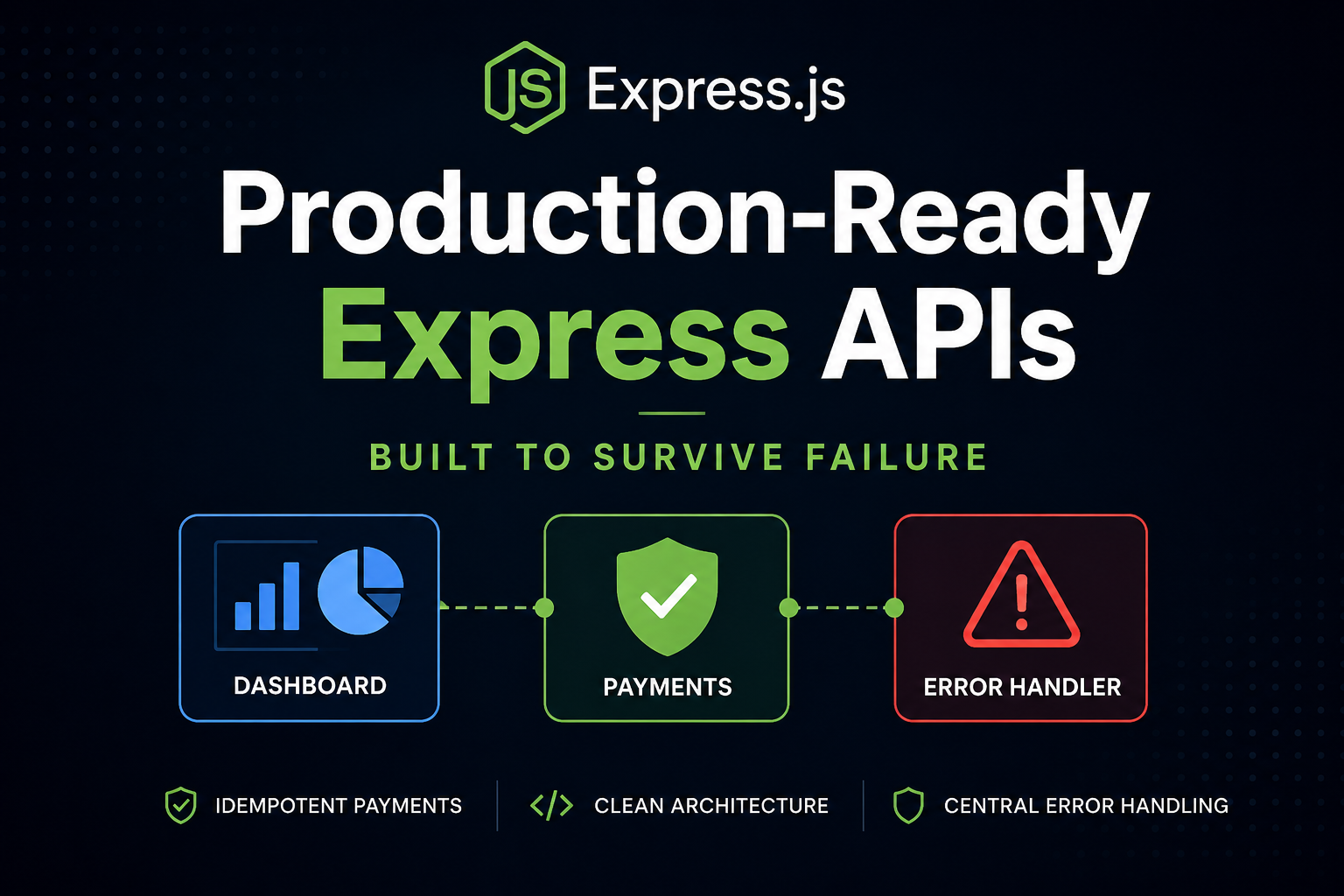
Before we look at the features, we need to look at the foundations. We established two global utilities at the top of our application to handle the structural formatting and remove the ugly try/catch and next(err) boilerplate from every route:
const express = require('express');const app = express();app.use(express.json());
// Global utility for perfectly consistent success responses across the appconst sendSuccess = (res, data, statusCode = 200) => {    return res.status(statusCode).json({        status: 'SUCCESS',        timestamp: new Date().toISOString(),        data    });};
// Async controller wrapper primitive: intercepts unhandled errors and pipes them to our global handler automaticallyconst useAsync = (fn) => (req, res, next) => {    Promise.resolve(fn(req, res, next)).catch(next);};
// Standardized Custom Error Class to enforce error propertiesclass AppError extends Error {    constructor(message, statusCode, type = 'INTERNAL_ERROR') {        super(message);        this.statusCode = statusCode;        this.type = type;        Error.captureStackTrace(this, this.constructor);    }}
Part 1: The Decoupled Dashboard Section
Our original analytics dashboard suffered from serious performance degradation. When a user loaded the page, a single database controller executed heavy SQL log queries alongside critical revenue aggregation queries. If the logging database lagged, the entire page hung blank.
To fix this, we decoupled the views. The frontend now calls completely separate endpoints in parallel. We also wrapped the flaky background logs endpoint in our new AppError class, passing a distinct DEGRADED_PERFORMANCE type flag so that a minor log timeout doesn’t bring down the main system state.
Notice how clean the routes look without a single try/catch block:
// 1. Critical Revenue Fetch: High priority, isolated, and incredibly fastapp.get('/api/v1/dashboard/revenue', useAsync(async (req, res) => {    const revenueData = { monthlyRevenue: 145200, currency: 'USD' };    sendSuccess(res, revenueData);}));
// 2. Heavy Activity Logs Fetch: Prone to timeouts under massive read volumeapp.get('/api/v1/dashboard/system-logs', useAsync(async (req, res) => {    // Simulating a real-world infrastructure hiccup (20% failure rate)    if (Math.random() > 0.8) {        throw new AppError('Database timeout fetching heavy system logs.', 206, 'DEGRADED_PERFORMANCE');    }
    const logData = { logs: ['System healthy', 'Worker #2 restarted'] };    sendSuccess(res, logData);}));
Part 2: The Resilient Billing & Payment Section
Next came our biggest production nightmare: double-billing. When users on erratic mobile connections hit our billing endpoint, requests frequently timed out on the client side while still processing on the server. Frustrated users would mash the checkout button, creating multiple charges for a single subscription tier.
We resolved this by writing an enterprise idempotency guardrail middleware using a high-speed cache layer. The client generates a unique transaction UUID and attaches it to the request header. If the network drops and the client automatically retries, the server catches the duplicate header before hitting our payment processing gateway.
Here is how the billing middleware and checkout route are safely tied together:
// In-memory cache simulating a fast infrastructure database like Redisconst RedisCache = new Map();
const enforceIdempotency = (req, res, next) => {    const idempotencyKey = req.headers['idempotency-key'];
    // Enforce safe habits on the frontend    if (!idempotencyKey) {        throw new AppError('Idempotency-Key header is required for sensitive mutations.', 400, 'CRITICAL_MISSING_HEADER');    }
    // If the key exists, it means we already received this exact request!    if (RedisCache.has(idempotencyKey)) {        const cachedResponse = RedisCache.get(idempotencyKey);        return res.status(200).json({            ...cachedResponse,            _idempotent_retry: true // Transparent trace tracking for debugging team        });    }
    // Intercept and wrap the response method to automatically cache successful payments    res.sendAndCache = (data) => {        const payload = {            status: 'SUCCESS',            timestamp: new Date().toISOString(),            data        };        RedisCache.set(idempotencyKey, payload);        return res.status(200).json(payload);    };
    next();};
// Secure Charge Endpointapp.post('/api/v1/payments/charge', enforceIdempotency, useAsync(async (req, res) => {    const { amount } = req.body;
    // Simulate standard, sensitive processing logic    const transactionResult = {        transactionId: 'tx_' + Math.random().toString(36).substr(2, 9),        amountCharged: amount    };
    // Safely send response and commit to Redis cache    res.sendAndCache(transactionResult);}));
Part 3: The Central Error Perimeter
Finally, our story ends at the bottom of the stack. Because our useAsync utility intercepts failures and routes throw statements down the chain, we need one central clearinghouse to handle logs, format error patterns, and deliver clean, non-leaky error responses back to the user interface.
// Centralized global error handling middlewareapp.use((err, req, res, next) => {    const statusCode = err.statusCode || 500;    const errorType = err.type || 'INTERNAL_SERVER_ERROR';
    // Structured JSON log output for ingestion tools like Datadog or ELK    console.error(JSON.stringify({        timestamp: new Date().toISOString(),        route: req.originalUrl,        type: errorType,        error: err.message,        stack: err.stack    }));
    // Respond back to the frontend with an identical layout structure for easy parsing    res.status(statusCode).json({        status: 'ERROR',        timestamp: new Date().toISOString(),        error: {            type: errorType,            message: err.message        }    });});
app.listen(3000, () => console.log('Production hardened server running on port 3000'));
Conclusion
Building for production means moving away from a mindset of “does it work?” to “what happens when it breaks?”
By decoupling your dashboard APIs, automating error handling with a clean async wrapper, and locking down payments with idempotency keys, you shift resilience from your individual features into your application’s core architecture. The result is a codebase that is clean, free of boilerplate, and ready to survive real-world production chaos.